
How to Find Your Sewer Line: A Homeowner’s Guide
Whether you are planning a landscaping overhaul, preparing for a plumbing repair, or troubleshooting a drain that refuses to clear, knowing exactly where your main sewer line runs is not optional information: it is foundational. Dig in the wrong spot, and you risk cracking the pipe you were trying to protect. Ignore the line’s path entirely, and a landscaping contractor might do the same with a trenching machine.
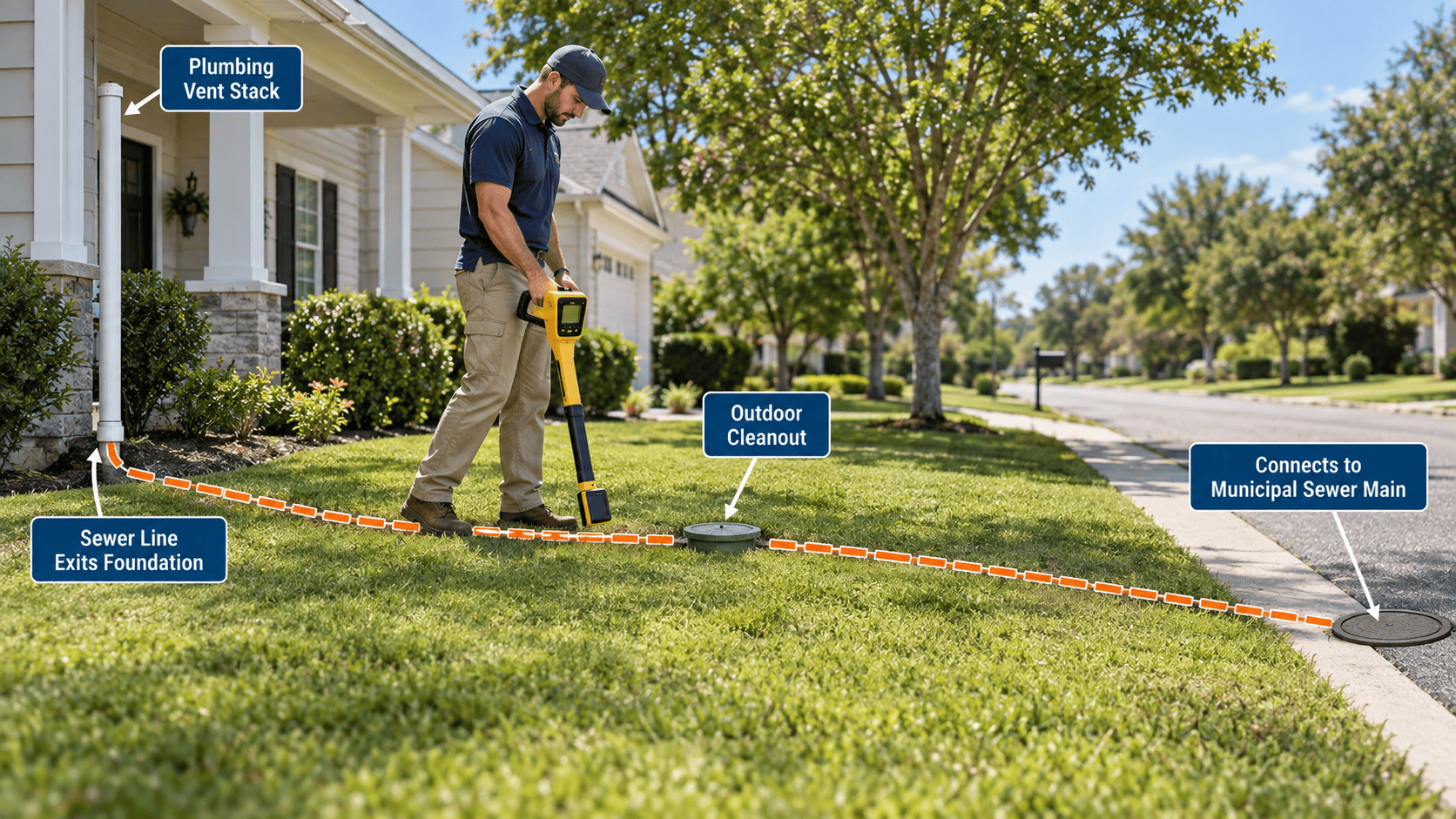
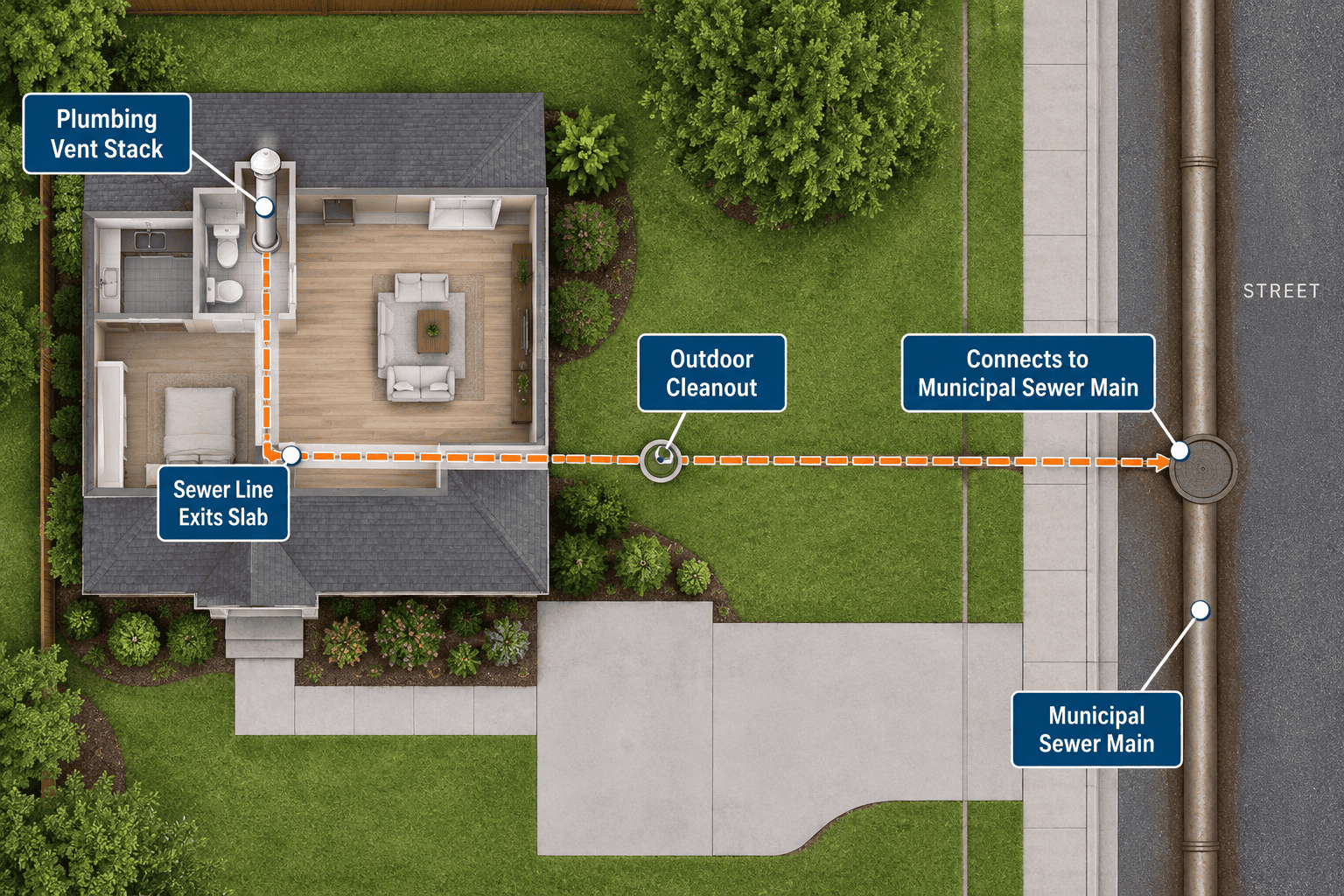
The good news is that you do not need to excavate your yard to answer this question. There is a systematic, non-invasive approach that starts inside your home and works outward, tracing the pipe’s path from your indoor plumbing stack, through the slab, to your outdoor cleanout, and finally to the municipal connection at the street. We call this inside-out mapping, and it is the same logical sequence a professional plumber uses before any camera or locator equipment ever touches the ground.
At Heaton Plumbing, family-owned since 1985 with an A+ BBB rating, we have walked thousands of Houston-area homeowners through this exact process. This guide gives you the same framework we use in the field, written in plain English with no confusing jargon, organized so you can work through it at your own pace.
Finding Your Home’s Sewer Line: The Inside-Out Mapping Strategy
Tracing Your Indoor Plumbing Stack
Every drain in your home, every toilet, sink, shower, and floor drain, eventually feeds into a single large vertical pipe called the main plumbing vent stack. This stack is typically 3 to 4 inches in diameter, constructed of either cast iron in older homes or PVC in newer construction, and it runs vertically from the lowest level of the home straight up through the roof. That roof penetration is usually visible from the street if you know what you are looking for: a plain pipe stub rising above the roofline, without a cap, designed to vent sewer gases safely into the open air.
Your task indoors is to find where this stack descends into the home’s lowest accessible level: the utility closet, the garage, the laundry room, or wherever your mechanical systems are concentrated. In most homes, this is also where you will find the water heater, the main water shutoff, and sometimes the electrical panel. The stack will be the largest drain pipe in the room, running vertically and often connected to a horizontal drain line that disappears into the floor or wall. That horizontal run is the beginning of your sewer line’s path out of the house.
Once you have identified the stack’s base, you have established your starting point. Everything downstream of that junction, the pipe running horizontally toward the street, is what we are trying to map. Pay attention to any symptoms in this area as well. Gurgling sounds, slow drains throughout the house, or sewage odors near floor-level drains can all be broken sewer line signs that point to a problem in the main line rather than an isolated fixture.
Locating the Exit Point Through Your Slab Foundation
In Houston and across most of the Gulf Coast region, homes are built on concrete slab foundations rather than basements or crawl spaces. This architectural reality changes how you trace the sewer line, because there is no exposed underfloor space to inspect. The main drain line exits the home by passing directly through the concrete slab, and from there, it runs underground toward the street.
To find the slab foundation exit point, stand inside the home at the base of your plumbing stack and note which exterior wall is closest to the street or the municipal sewer main. In most residential layouts, the line exits through or near that wall. Walk outside and examine the perimeter of the foundation in that area. You are looking for any ground disturbance, a slight depression, or a cleanout pipe stub that marks where the line transitions from inside the slab to underground. From that exit point, the sewer line almost always runs in a straight, uninterrupted path toward the street, with no curves or jogs, because any deviation adds complexity and cost that builders and plumbers historically avoid.
This straight-line principle is one of the most useful assumptions in residential sewer mapping. If you can identify the exit point and the approximate location of the municipal connection at the street, you can draw a reasonably accurate line between the two and know where the pipe is buried.
Locating the Main Sewer Cleanout on Your Property
What a Sewer Cleanout Looks Like and Why It Matters
The main sewer cleanout is the access point that makes everything else manageable. It is a short section of pipe, usually the same material as your sewer line, that extends slightly above ground level and terminates with a threaded cap. That cap typically features a square notch or slot on top, designed to accept a large wrench for removal. In some cases, the cleanout sits flush with the ground surface or has been covered by mulch, sod, or a decorative ground box over the years.
Its function is simple: the cleanout gives plumbers a direct entry point into the main sewer line without having to access the line through a toilet or floor drain. When a blockage occurs, a plumber inserts a drain cable or camera through the cleanout to diagnose and clear the obstruction. When you know where your cleanout is, you can direct a plumber to it immediately rather than spending the first thirty minutes of a service call hunting for it. Local plumbing codes govern how these access points are installed and spaced. If you want to understand the regulatory framework behind plumbing cleanout spacing, those requirements explain why your cleanout is positioned where it is.
Common Locations to Search Around Your Home
Cleanouts are not always obvious, especially on properties that have been landscaped multiple times over the decades. Search these areas systematically:
- Near the foundation wall: Start within 3 to 5 feet of where the main plumbing stack exits the home. This is the most common placement, positioned to give direct access to the line before it runs deep underground.
- Near the property line: Some cleanouts are installed close to the sidewalk, curb, or utility easement, at the point where your private lateral line hands off to the city main. These are often set in small concrete collars or plastic ground boxes.
- Hidden under landscaping: Decades of mulching, sodding, and planting can bury a cleanout completely. Probe the ground with a thin rod along the expected line path, and check inside decorative ground covers or behind foundation plantings.
- Inside the garage or utility room: On some slab-on-grade homes, particularly those built before outdoor cleanout placement became standard practice, the cleanout may be located indoors near the water heater or main shutoff valve.
Get Peace of Mind with Heaton Plumbing’s Upfront Pricing
If you have searched the perimeter and still cannot locate your cleanout, or if you suspect the line has a problem beyond a simple access issue, you do not have to keep guessing. Heaton Plumbing’s team is available to locate, assess, and address your sewer line with no surprises on the invoice. You’ll know the exact cost before we start, and our work is backed by our done right or it’s free guarantee.
For sewer line repair and replacement in Houston, call us at (281) 842-7473. We offer 24/7 emergency availability and are open 7 A.M to 7 P.M., 7 Days a Week!
Non-Invasive Methods to Locate Your Sewer Line Without Digging
Utilizing Public Records and City Utility Maps
Before you probe a single inch of soil, check what already exists on paper. When your home was built, a licensed engineer or surveyor submitted a site plan to the local municipal building department, a document that typically shows the layout of all utility connections, including the sewer lateral. These records are public, and you can request copies from your local building department, county clerk’s office, or city public works division. In many municipalities, the request can be made online.
Property plot maps are particularly useful because they often include the precise path of the private sewer lateral, the location of the cleanout, and the point of connection to the municipal main. Some Houston-area municipal utility districts (MUDs) and public works departments also maintain GIS mapping databases that can be queried by address. The quality and completeness of these records vary, as older homes may have sparse documentation, but it is always worth checking before resorting to physical investigation.
If your home was built within the last few decades, there is a reasonable chance the original construction drawings are still on file and include a plumbing schematic. That single document can save you hours of outdoor searching.
Reading the Signs: Lawn Anomalies and Soil Shifting
Your yard can tell you a great deal about what is happening underground, if you know how to read it. A sewer line that has developed even a minor joint separation or hairline crack will release moisture and nutrients into the surrounding soil. The result is often a strip of grass that grows noticeably faster, greener, or taller than the lawn on either side: a narrow band of lush growth running in a straight line from the house toward the street. It is subtle, but once you know to look for it, it becomes one of the more reliable visual indicators of a line’s path.
Soil depressions are the other major clue. When a pipe begins to settle, corrode, or collapse, the soil above it can shift downward, creating a shallow trough or soft spot along the line’s path. In Houston, this phenomenon is amplified by the region’s highly expansive clay soils, which undergo dramatic shrink-swell cycles as they absorb and release moisture through the seasons. A depression that appears after a dry summer or a wet spring is worth investigating, particularly if it aligns with the straight-line path you have already estimated from the indoor stack to the street.
Neither of these signs is definitive on its own. A strip of green grass might reflect a buried irrigation line or a low spot that collects runoff. A soil depression might be unrelated to the sewer entirely. But when these anomalies appear in alignment with your estimated line path, they significantly narrow the search area.
Safe DIY Methods for Mapping the Pipe’s Path
Once you have a rough estimate of the line’s path from indoor tracing and public records, a few low-risk physical methods can help you confirm it:
- Use a thin metal probe rod: Insert a soil probe carefully into the ground along the estimated path, pressing until you feel the resistance of a hard surface below. This works best in softer soils and at shallower depths. Exercise extreme caution: call 811 to have underground utilities marked before probing anywhere in your yard.
- Trace the line from the roof vent: Stand at the street and sight back toward the roof vent stack. The pipe’s path underground should run roughly along that same axis, giving you a directional bearing to work with.
- Review your home’s original blueprint: If you have the construction drawings, locate the plumbing schematic page. It will show the engineered layout of all drain lines, including the main lateral’s path and the cleanout’s position.
- Understand the limits of basic tools: Read our guide on buying a drain snake to understand what consumer-grade equipment can and cannot do when it comes to diagnosing main line issues.
A Word of Caution on Commercial Locator Rentals
“Renting commercial plumbing snakes equipped with radio transmitters (sondes) might seem like a cost-effective DIY shortcut, but forcing these rigid tools down fragile clay or cast-iron pipes can easily crack the line, turning a simple search into an expensive excavation project.”
Rental costs for sonde-equipped equipment vary, and the price of the rental itself is rarely the largest risk. The larger concern is that these tools require trained hands. A professional knows how to read the transmitter signal, navigate bends without stressing the pipe wall, and interpret what the locator wand is actually telling them. Without that experience, you can damage a pipe that was otherwise intact, and at that point, the search for the line’s location becomes the least of your problems.
Understanding Sewer Line Depth and Municipal Easement Boundaries
Soil Dynamics and Sewer Line Depth in Houston
Sewer line depth is not a fixed number, and anyone who gives you a single figure without knowing your property’s specifics is guessing. Depth varies based on local climate, topography, the age of the installation, and the slope required to maintain gravity flow. In northern climates, lines are buried well below the frost line to prevent freezing, which can push them several feet underground. In warmer, southern regions like Houston, that frost-line constraint disappears, so lines are typically installed at shallower depths.
Shallower burial has its own complications in Houston’s environment. The region’s high seasonal rainfall, combined with a water table that can sit surprisingly close to the surface in low-lying areas, means that shallow sewer lines are more exposed to hydrostatic pressure, soil movement, and root intrusion from nearby trees and shrubs. Houston’s expansive clay soils shift with every significant wet-dry cycle, and those movements exert lateral pressure on pipe joints over time. This is part of why the city’s aging sewer infrastructure requires ongoing attention, a reality reflected in federal funding priorities. In April 2026, the EPA announced approximately $81 million in grants through the EPA Sewer Overflow and Stormwater Reuse Municipal Grants Program to support communities managing combined sewer overflows, sanitary sewer overflows, and stormwater challenges, with at least 25 percent of each state’s allocation directed toward rural or financially distressed communities facing the highest infrastructure burdens.
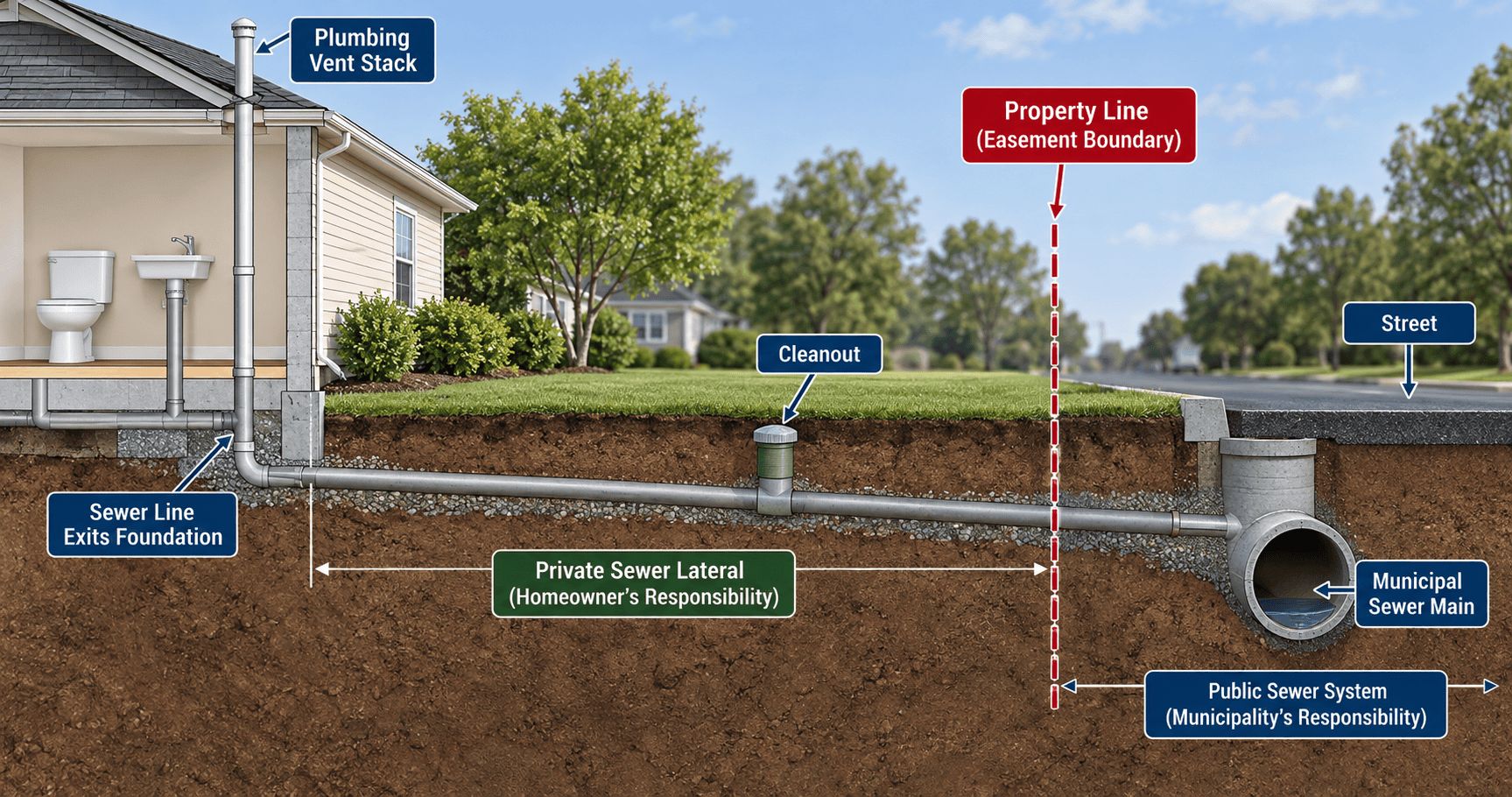
Your private sewer lateral connects to that larger public system at the property line or utility easement. Understanding where that boundary falls matters because your maintenance responsibility ends there: everything from the house to the connection point is yours; everything beyond it belongs to the municipality.
Schedule a Professional Diagnostic Assessment
Mapping your line’s approximate path is a meaningful first step, but it tells you nothing about the pipe’s internal condition. A line can run exactly where you expect it to and still be partially collapsed, heavily root-infiltrated, or corroded at the joints, none of which is visible from the surface.
Heaton Plumbing has been diagnosing and repairing Houston sewer systems since 1985. Our A+ BBB rating and best parts and labor warranties reflect a straightforward commitment: you’ll know the exact cost before we start, there are no hidden fees, and our work is backed by our done right, or it’s free guarantee. When you are ready to move from surface mapping to a verified assessment of what is actually inside the pipe, we are here.
Call us at (281) 842-7473. We offer 24/7 emergency availability and are open 7 A.M to 7 P.M., 7 Days a Week!
When to Stop: Recognizing the Limits of DIY Sewer Line Locating
Critical Warning Signs That Require Immediate Professional Help
Some symptoms cannot wait for a methodical mapping exercise. If you encounter any of the following, stop the DIY investigation and call a licensed plumber:
- Multiple drains backing up at the same time: For example, flushing the toilet causes water to bubble up into the shower or bathtub. This pattern almost always points to a blockage or failure in the main line rather than an individual fixture.
- Persistent sewage odors inside the home or near outdoor drains: This is especially true for odors that linger even after cleaning. Sewer gas contains hydrogen sulfide, which is both unpleasant and potentially hazardous at elevated concentrations.
- Soft, soggy ground or standing water in the yard during dry weather: This is highly concerning, particularly along the estimated path of the sewer line. Saturated soil above a buried pipe is a strong indicator of an active leak.
- Gurgling or bubbling sounds from toilets or floor drains when other fixtures are running: An example is a washing machine draining and causing the toilet to gurgle. This is the system telling you that air is being displaced somewhere it should not be.
Tree root intrusion is one of the primary causes of main sewer line failures, and it is worth noting that roots are attracted to the moisture and nutrients inside even a hairline crack. By the time surface symptoms appear, root infiltration is often already well established inside the pipe.
The Hidden Risks of Advanced DIY Locating Tools
There is a meaningful difference between the low-risk methods described earlier, probing, record-checking, reading lawn anomalies, and the more aggressive approaches some homeowners attempt when those methods do not produce a clear answer. Digging exploratory trenches, renting excavation equipment, or inserting heavy rigid tools into aging pipes all carry risks that are easy to underestimate.
The most serious hazard is striking a buried utility line. Electrical conduit, gas lines, and water mains often share the same general corridor as your sewer lateral, and they are not always where the utility maps say they are. A shovel through a gas line is not a plumbing problem; it is an emergency. This is why calling 811 before any digging is not just a recommendation: in most states, it is a legal requirement.
Professional plumbers approach this differently. Non-invasive sewer cameras, flexible, waterproof inspection cameras fed through the cleanout, can map the pipe’s path, identify obstructions, locate joint separations, and pinpoint root intrusion without disturbing a single square foot of your yard. Electronic line locators paired with a camera transmitter can then trace the pipe’s path above ground with precision that no probe rod or visual inspection can match. The technology exists specifically to eliminate the guesswork that makes DIY locating risky.
When the surface-level investigation has reached its limit, that is the moment to hand it off. Knowing when to stop is as valuable as knowing where to start.
Frequently Asked Questions About Residential Sewer Lines
How do I find my sewer line map?
Contact your local municipal building department, city public works office, or local utility provider and request your property’s site plan or construction records. These documents often include the engineered layout of your sewer lateral. Many municipalities also offer GIS-based utility mapping tools accessible online by address. If your property falls within a municipal utility district (MUD), the MUD’s administrative office is another useful starting point. For the specific width of any sewer easement on your property, check your property survey or consult the city’s official maps directly. Easement dimensions vary by municipality and are not standardized across jurisdictions.
How do I tell if my main sewer line is clogged?
The clearest indicator is multiple fixtures backing up or behaving abnormally at the same time. A single slow drain usually points to a localized clog in that fixture’s branch line. When the toilet gurgles while the washing machine drains, or when water backs up into the tub when you flush, the problem is almost certainly in the main line. Sewage odors near floor drains, water pooling around a floor drain when other fixtures run, and persistent gurgling from drains that seem otherwise functional are all consistent with a partial or complete main line obstruction.
How deep is the sewer line in my yard?
Depth varies considerably depending on local climate, the topography of your property, and when the line was installed. In colder northern climates, sewer lines are buried well below the frost line to prevent freezing, which can mean several feet of cover. In warmer southern regions like Houston, frost is not a design constraint, so lines tend to be installed at shallower depths to maintain the gravity slope needed for proper flow. The specific depth on your property depends on your yard’s grade, the distance to the municipal connection, and the installation practices in effect when your home was built. A sewer camera inspection will confirm the actual depth at any given point along the line.
Can you fix a sewer line without digging?
In many cases, yes. Trenchless repair methods have become the preferred approach for lines that are damaged but still structurally intact enough to serve as a host. Cured-in-place pipe (CIPP) lining involves pulling or inverting a resin-saturated liner into the existing pipe and curing it in place, creating a smooth new pipe wall inside the old one. Pipe bursting is a different method: a bursting head is pulled through the old pipe, fracturing it outward while simultaneously pulling a new pipe into position. Both approaches require access through the cleanout or a small excavation at each end, but they eliminate the need for a full trench along the line’s path. Whether trenchless repair is appropriate depends on the pipe’s current condition, which is why a camera inspection always precedes any repair recommendation.
What can I pour down my sewer line to unclog it?
For minor slow-downs in a single fixture, a mixture of baking soda and vinegar followed by hot water can sometimes break up soft organic buildup. Enzymatic drain cleaners, products that use biological cultures to digest grease and organic matter, are a gentler option for routine maintenance. What you should avoid are harsh chemical drain cleaners, particularly those based on sulfuric acid or lye. These products can soften or degrade older PVC pipe, corrode cast iron, and are rarely effective against the kind of obstruction that causes a main line backup. If multiple drains are affected, no poured solution will address the root cause: the blockage is too far downstream and too substantial for anything you can introduce from a fixture drain.
Schedule an Inspection Today
Locating your sewer line does not have to be an overwhelming project. With a methodical approach, starting at the indoor stack, tracing the exit point through the slab, searching for the cleanout, and cross-referencing public records, most homeowners can establish a reliable map of their line’s path without touching a shovel. The process takes patience and some careful observation, but it is genuinely within reach.
Where it gets more complicated is when the surface evidence is ambiguous, the records are incomplete, or the symptoms suggest something is already wrong inside the pipe. At that point, the most practical decision is also the safest one: bring in a professional with the right equipment to confirm what you cannot see from the surface.
Heaton Plumbing has been serving Houston homeowners since 1985. Our A+ BBB rating and best parts and labor warranties reflect the same commitment we have held since the beginning: clear communication, transparent pricing, and work that holds up over time. Whether you need a cleanout located, a line mapped, or a full diagnostic assessment, we are here to help you move forward with confidence.
Ready to know exactly what is happening inside your sewer line? Schedule a sewer line camera inspection with Heaton Plumbing and get a complete picture of your pipe’s condition: no guesswork, no surprises. Call us at (281) 842-7473 to book your appointment. We offer 24/7 emergency availability and are open 7 A.M to 7 P.M., 7 Days a Week!